
TL;DR: Are sex dolls legal?
- Adult-presenting dolls: in several major markets reviewed—including the United States, Canada, Germany, France, and the Netherlands—we found no law that makes private possession of every adult-presenting doll automatically illegal. That is not worldwide permission: import, sale, advertising, customs, product-safety, and state or local rules may produce a different answer.
- Child-appearing products: these create the highest criminal and seizure risk. Germany and the Netherlands have express offences, several US states prohibit defined child sex dolls, and important judicial or enforcement precedents exist in Canada, Germany, Norway, France, and South Korea.
- There is no universal age or height rule: a manufacturer’s “18+” label, fictional biography, or height above 140 cm is not a legal safe harbour. Authorities may assess the complete appearance, proportions, features, name, accessories, marketing, and intended function.
- Import and possession are different questions: a product may be lawful to possess but prohibited at the border, or its sale, display, or advertising may be restricted even where private possession is not.
- Shipping availability is not legal approval: we screen destinations and may refuse or cancel an order when we identify a prohibition or cannot reach a sufficiently reliable conclusion. Acceptance of an order does not guarantee customs clearance.
Why “legal” is not one question
A statement such as “sex dolls are legal in Country X” is usually too broad. At least five different questions need separate answers:
- Private possession: may an adult keep the particular item at home?
- Import and transit: may it cross the border or pass through an intermediate country?
- Sale and supply: may it be manufactured, offered, sold, rented, delivered, or otherwise distributed?
- Advertising and display: may the listing, images, wording, and public display be shown to adults or minors?
- Product compliance: does the product meet separate safety, labelling, electrical, chemical, data-protection, consumer, and marketplace rules?
A country may allow private possession but prohibit import, or prohibit sale without creating an offence of simple possession. A customs clearance decision also does not necessarily answer whether later possession, resale, display, or use is lawful.
Terms used in this guide
- Adult-presenting product: a product whose overall appearance, features, description, and marketing represent an adult. This is a descriptive term, not a universal legal category.
- Child-appearing product: a product that a regulator, customs officer, court, or reasonable observer may regard as representing a child or person below the locally relevant age. Statutory wording and thresholds differ.
- No specific ban identified: the sources reviewed did not reveal a law directed specifically at the stated product or conduct. It does not mean “guaranteed legal”; general and local laws may still apply.
- Express prohibition: legislation or binding case law expressly addresses the product or clearly includes it within a defined prohibited category.
Are sex dolls legal in the USA, Canada and Europe?
The following buyer-focused sections address the markets most frequently requested by our readers. Each answer separates adult-presenting products from child-appearing products and distinguishes private possession from import, sale, and advertising.
Are sex dolls legal in the United States?
Adult-presenting products: we identified no federal statute that prohibits a conventional adult-presenting doll merely because it is a sex doll. That does not create nationwide immunity: federal obscenity and prohibited-import rules can apply to a particular object or transaction, while state and local law may add restrictions.
Child-appearing products: there was no enacted federal doll-specific prohibition at the research cut-off, but at least twelve states—Arizona, Arkansas, Florida, Hawaii, Kentucky, Louisiana, North Carolina, South Dakota, Tennessee, Texas, Utah, and Wisconsin—expressly criminalised possession of products meeting their definitions. The states do not share one age test: their statutes variously refer to a minor, a person under 18, a younger child, or appearance below puberty. Rules on import, transport, transfer, and commercial conduct also differ. A Missouri amendment was scheduled to take effect on 28 August 2026, six days after this guide’s cut-off.
Buyer takeaway: “adult dolls are legal nationwide” and “childlike dolls are federally banned” are both inaccurate shortcuts. Check the destination state and locality as well as federal border law. A proposed federal CREEPER Act remained a bill, not enacted law.
Key authorities: May 2026 state-law survey; 19 U.S.C. § 1305; H.R. 1186 status.
Are sex dolls legal in Canada?
Adult-presenting products: Canada Border Services Agency guidance says sex aids and toys are not treated as obscene merely because they are sexual. A particular product may still be examined under the Customs Tariff and Criminal Code.
Child-appearing products and precedent: Criminal Code section 163.1 can apply if the complete object meets the statutory definition of child sexual abuse and exploitation material. In R v Goodenough, 2025 ONCJ 74, an Ontario trial judge held that the particular modified 50 cm child’s doll was a prohibited visual representation. The court considered the object’s size, facial and physical appearance, modification, sexual characteristics, intended function, and the accused’s knowledge. This is a fact-specific trial judgment—not a Supreme Court ruling and not a universal dimensions test.
Buyer takeaway: ordinary adult sex aids are not automatically obscene, but a product satisfying section 163.1 can engage separate offences for making, advertising, sale, distribution, import/export, and possession. A youthful feature or height alone is not the statutory test.
Key authorities: CBSA Memorandum D9-1-1; Criminal Code § 163.1; R v Goodenough.
Are sex dolls legal in the European Union?
EU-wide position: as of 22 August 2026, we identified no harmonised EU offence specifically banning adult-presenting sex dolls or creating one uniform child-doll possession offence. National criminal, obscenity, customs, and child-protection law remains decisive. EU institutions reached a provisional agreement on revised child-sexual-abuse criminal law in June 2026, but formal adoption and later national implementation were still outstanding at the cut-off. The public agreement summary does not establish a specific EU-wide doll offence.
Separate EU obligations: the Digital Services Act regulates platform systems and illegal-product handling, while the General Product Safety Regulation governs matters such as product safety, traceability, responsible economic operators, warnings, and online-offer information. These frameworks do not themselves decide that every sex doll is lawful or unlawful.
Buyer takeaway: “legal in the EU” is incomplete. Check the destination member state and the particular conduct. Germany, the Netherlands, Denmark, Belgium, France, Austria, Spain, Italy, Poland, and Czechia do not have identical rules.
Key authorities: Directive 2011/93/EU; June 2026 provisional agreement; recast legislative procedure; General Product Safety Regulation.
Are sex dolls legal in Germany?
Adult-presenting products: we identified no German provision banning a product merely because it is an adult-presenting sex doll. General product, consumer, advertising, public-display, and other rules still apply.
Child-appearing products and precedent: Criminal Code § 184l expressly covers physical replicas of children or child body parts intended by their nature for sexual acts; in German criminal law, “child” means a person under 14. The section prohibits specified manufacture, marketing, trade, supply, import/transit, acquisition, and possession. On 21 May 2026, the Federal Constitutional Court upheld the provision and required a restrictive, overall assessment: the appearance must be unequivocally childlike, fixed measurements are unnecessary, and ambiguous traits also found in adults are insufficient on their own. Small size alone may be insufficient where pronounced adult characteristics point the other way. The judgment supplies no 140 cm rule.
Buyer takeaway: Germany has one of the clearest express prohibitions in Europe. A product name or “18+” statement cannot replace the holistic statutory assessment.
Key authorities: German Criminal Code § 184l; Federal Constitutional Court judgment; official English summary.
Are sex dolls legal in France?
Adult-presenting products: the sources reviewed did not reveal a specific offence of privately possessing every adult-presenting sex doll. Online listing content, effective age-gating, import, sale, and public display remain separate questions.
Child-appearing products and enforcement: in November 2025, France’s consumer authority referred Shein listings for child-appearing dolls to prosecutors under rules concerning child sexual abuse representations. A March 2026 government update reported an ongoing judicial investigation concerning sale and an age-verification measure for pornographic products. It also reported that the Paris court rejected the government’s initial platform-blocking request and that an appeal was pending. That procedural result did not legalise the listings. These are serious enforcement developments, but not a final merits judgment establishing that simple private possession of every physical child-appearing doll is categorically illegal.
Buyer takeaway: child-appearing products, their online presentation, sale, and import should be treated as extremely high risk. The boundary for possession of a physical object should not be overstated without a product-specific French decision.
Key authorities: Penal Code article 227-23; DGCCRF referral; March 2026 update.
Are sex dolls legal in the Netherlands?
Adult-presenting products: we identified no provision banning a product merely because it is an adult-presenting sex doll, subject to other generally applicable law.
Child-appearing products: Criminal Code article 253a, effective 1 January 2025, applies to an object that appears to be a child under 16—or part of such a child—and is intended for sexual acts. It covers distribution, offering, public display, manufacture, import, transit, export, acquisition, and possession. Legislative materials point to the realistic overall appearance, face, size and proportions, accessories, and sexual functionality; anatomical precision is unnecessary, and an owner’s claimed subjective intention does not control the object’s intended function. No reported article 253a judgment was located.
Buyer takeaway: the Netherlands now has an express and broad statutory prohibition. The under-16 threshold concerns apparent representation; a seller’s stated age does not control.
Key authorities: current Criminal Code article 253a; commencement decree.
What about the rest of the EU and Europe?
- Denmark: § 235a expressly prohibits manufacture, sale, transfer, and possession of a child-appearing doll made for a sexual purpose. Import is not separately named but can create possession or transfer.
- Belgium: no doll-specific current offence or controlling physical-doll judgment was located. Broad existing provisions concerning visually represented material create substantial but unresolved classification risk. The explanatory memorandum to the incoming Code expressly confirms doll and robot coverage; the new Code’s effective date was postponed to 1 September 2026.
- Austria: profit-motivated commercial dealing and import can engage obscenity law, but no clear doll-specific simple private-possession offence was identified.
- Spain and Italy: child-pornography provisions principally concern images or defined visual material, while commercial obscenity law may apply to physical objects. No clear doll-specific blanket private-possession offence was located.
- Poland: the Justice Ministry stated in October 2025 that possession of sexual-satisfaction objects was generally not specifically criminalised; other pornography and child-protection rules remain relevant.
- Czechia: comparative government-commissioned research reports that broad child-pornography law is interpreted to cover childlike dolls, but no express doll-specific statute or apex judgment was located.
- Norway (outside the EU): the Supreme Court held in 2019 that Penal Code § 311 covered the particular childlike doll, including liability arising from purchase/import.
Other EU member states: this edition did not establish a doll-specific primary-law conclusion for Bulgaria, Croatia, Cyprus, Estonia, Finland, Greece, Hungary, Ireland, Latvia, Lithuania, Luxembourg, Malta, Portugal, Romania, Slovakia, Slovenia, or Sweden. That is a research limitation—not a finding that import, possession, sale, or advertising is legal.
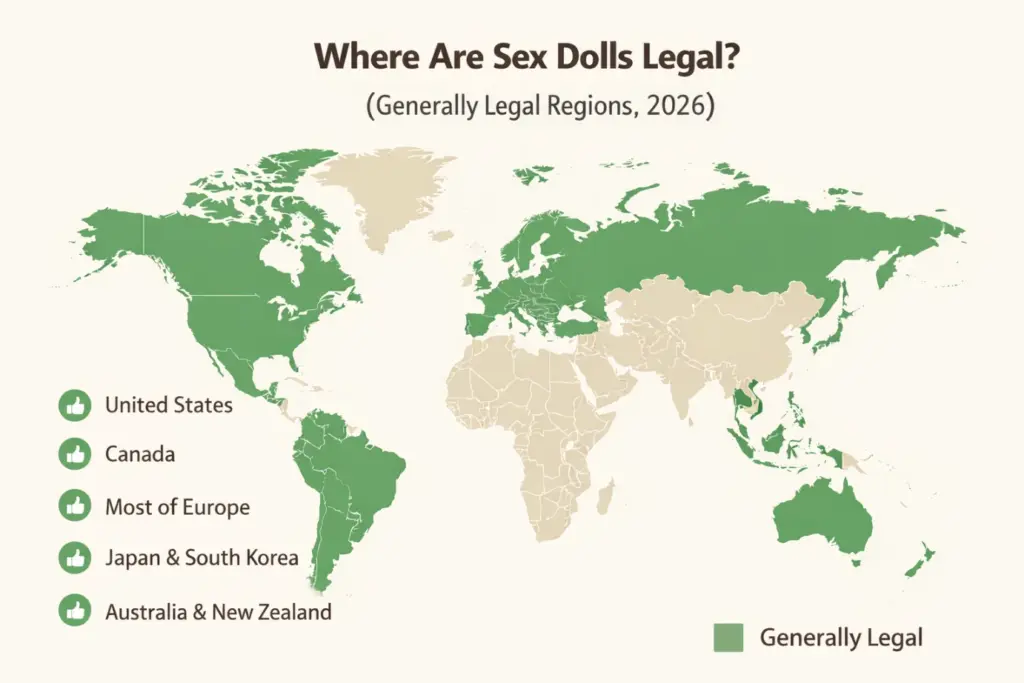
Global country-by-country best-effort source review
The detailed priority-market sections above are summarised here alongside other jurisdictions. This table is intentionally cautious. It describes legislation, guidance, and leading decisions found in our source review; it is not an exhaustive opinion on every national, state, provincial, territorial, or municipal rule.
| Jurisdiction | Adult-presenting products | Child-appearing products / key restriction | Buyer takeaway from the cited sources |
|---|---|---|---|
| United States | No specific federal ban on private possession of an adult-presenting doll was identified. Federal obscenity and prohibited-import rules can still apply to a particular object or transaction, and state or local law may add restrictions. | There is no enacted federal doll-specific prohibition. At least twelve states—Arizona, Arkansas, Florida, Hawaii, Kentucky, Louisiana, North Carolina, South Dakota, Tennessee, Texas, Utah, and Wisconsin—expressly criminalise possession of their statutorily defined child sex dolls. Definitions, penalties, and import/transfer elements differ. A Missouri amendment is scheduled to take effect on 28 August 2026, after this guide’s cut-off. | Do not publish “legal nationwide” or “banned nationwide.” Check federal import/obscenity law and the current law of the destination state and locality. Federal CREEPER legislation remained a proposal, not law, at the review date. |
| United Kingdom | UK authorities have not treated ordinary adult dolls as automatically obscene, but classification remains product-specific. | UK-wide customs law can support prosecution for importing an obscene childlike doll. In England and Wales, CPS guidance also identifies possible offences for publication/sale and sending by post, but states that simple possession by itself is not an offence. | Separate import, knowing acquisition of a prohibited import, sale/publication, posting, and possession. CPS guidance governs prosecution practice in England and Wales; Scotland and Northern Ireland have distinct criminal systems. A new private member’s bill was pending, not law. |
| Canada | CBSA guidance says sex aids and toys are not, as a class, treated as obscene goods. A particular import may still be assessed under the Customs Tariff and Criminal Code. | Criminal Code section 163.1 can apply where a doll meets the definition of child sexual abuse material. In R v Goodenough (2025 ONCJ 74), an Ontario trial court held that the particular modified childlike doll was a prohibited visual representation; knowingly possessing it resulted in a conviction. | The original reference to section 163.1 as “obscenity” was incorrect: obscenity is section 163; section 163.1 concerns child sexual abuse material. |
| Australia | No specific federal offence directed at private possession of an adult-presenting doll was identified. Import controls and state or territory law still require review. | Federal Criminal Code section 273A.1 prohibits possessing a doll or other object that resembles a person who is, or appears to be, under 18 where a reasonable person would consider it likely intended for sexual use. Importation is separately prohibited and actively enforced. | This is an express federal prohibition. Australian Border Force reported new arrests and charges in 2025 and 2026. |
| New Zealand | No specific national ban on private possession of an adult-presenting doll was identified in the sources reviewed. | New Zealand Customs says sex toys or dolls considered indecent or obscene may be seized and may lead to prosecution. Customs has publicly prosecuted the import of a child sex doll. | Do not equate “no specific possession ban identified” with guaranteed import clearance. Selling, publicly distributing, or publicly displaying an indecent model or object may also be an offence. |
| European Union overview | No harmonised EU law specifically banning adult-presenting sex dolls was identified. National criminal and obscenity laws remain decisive. | There is not yet one harmonised EU-wide child-doll offence. A November 2025 European Parliament resolution called for stronger action, and the Commission opened a Digital Services Act investigation into Shein in February 2026 concerning illegal products, including childlike dolls. Those actions are important but are not themselves a uniform possession ban. | Check each member state. Separately, online offers to EU consumers must comply with applicable product-safety rules, including the General Product Safety Regulation. |
| Germany | No specific prohibition on adult-presenting dolls was identified, subject to general law and product compliance. | Criminal Code section 184l expressly covers physical replicas of children—persons under 14—intended for sexual acts. It prohibits specified commercial conduct and import, and also acquisition, possession, and import for possession. Germany’s Federal Constitutional Court upheld the provision in May 2026. | Express criminal prohibition; the complete product and its intended function matter. |
| Netherlands | No specific prohibition on adult-presenting dolls was identified, subject to general law and product compliance. | Criminal Code article 253a, effective 1 January 2025, covers objects appearing to be a child under 16 or part of such a child’s body and intended for sexual acts. It includes manufacture, import/export/transit, supply, acquisition, and possession. | Express criminal prohibition with a statutory under-16 appearance threshold. |
| Denmark | No specific prohibition on adult-presenting dolls was identified, subject to general law. | Criminal Code section 235a prohibits making, selling, or otherwise transferring a doll that appears as a child and is made for a sexual purpose; possession is separately prohibited. | Express criminal prohibition. Avoid replacing the statutory appearance test with a made-up height rule. |
| Norway | No specific prohibition on adult-presenting dolls was identified, subject to general law. | The Supreme Court held in 2019 that Penal Code section 311 covers a sexualised child doll. The section includes production, offering, sale, acquisition, import, and possession of prohibited representations. | Expressly covered by binding case law. Norway is not an EU member. |
| France | No specific ban on private possession of an adult-presenting doll was identified in the sources reviewed. Advertising and online access remain separate issues. | In November 2025, the consumer authority referred marketplace listings for child-appearing dolls to prosecutors under child sexual abuse representation rules. It separately highlighted ineffective age-gating for pornographic adult-doll content. That referral demonstrates serious listing and enforcement risk, but does not by itself prove a categorical offence of simple possession of every physical doll. | Treat child-appearing products and youth-accessible listings as prohibited operationally; obtain French advice before making a broader criminal-law claim. |
| Belgium | No specific ban on adult-presenting dolls was identified, subject to general, product, advertising, and consumer law. | Current Criminal Code articles 417/43–417/47 broadly concern visually represented child sexual abuse material and associated manufacture, import, supply, acquisition, and possession. No doll-specific current offence or controlling physical-doll judgment was located. The explanatory memorandum to the incoming Code expressly says childlike sex dolls and robots are covered. | The current physical-object classification is substantially risky but unresolved. Belgium’s new Code was formally postponed to 1 September 2026; it should not be cited as current before that date. |
| South Korea | In a 2026 judgment, the Supreme Court held that customs could not apply a blanket import hold to an adult real doll; officials must assess the particular item and circumstances. | Customs may still act where concrete facts establish obscenity or a public-morals risk. A separate 2021 Supreme Court decision supports stopping a realistic sexual tool modelled on the appearance of a person under 16, subject to factual assessment. | This is a product-specific customs decision, not a universal declaration that every adult doll may be imported, sold, or possessed. |
| Singapore | No specific adult-doll prohibition was identified, but obscene-object, import, and other laws may still apply to a particular item. | Penal Code section 292A defines a child sex-doll by resemblance to a person below 16 and sexual purpose. It prohibits import, export, conveyance, sale, hire, distribution, circulation, manufacture, production, and possession. | Express criminal prohibition with a below-16 appearance threshold and broad coverage of conduct. |
| Japan | Japan Customs prohibits obscene or immoral articles, but its published prohibited-items list does not specifically name sex dolls. No specific national adult-doll rule was verified. | The same customs list prohibits child pornography, but it does not establish on its face that every physical child-appearing doll is included. | Avoid saying categorically that adult dolls are “legal” or child-appearing dolls are “banned” without product-specific Japanese legal and customs confirmation. |
Additional European countries reviewed
The EU countries named in the previous article should not be treated as legally interchangeable:
- Austria: the Pornography Act creates substantial risk for profit-motivated manufacture, stocking, import, transport, export, offering, transfer, public display, and distribution of obscene objects. No clear doll-specific offence of simple private possession was identified.
- Spain: Criminal Code article 189 prohibits defined child pornography, including specified realistic images and visual representations, but does not expressly classify a three-dimensional physical doll. No controlling doll-specific decision was located.
- Italy: child-pornography provisions principally address material involving actual minors and specified realistic virtual images. Criminal Code article 528 separately regulates obscene objects made, imported, acquired, or held for trade or distribution, and public display. A clear doll-specific blanket offence covering private possession was not located.
- Poland: in an October 2025 response reported by the Children’s Rights Ombudsman, the Ministry of Justice said that possession of objects intended for sexual satisfaction was generally not specifically criminalised. Pornography offences and restrictions on supplying sexual objects to children remain relevant.
- Czechia: Criminal Code section 192 is broad, and comparative legal research commissioned by the Dutch government reports that it is interpreted to include childlike dolls. No Czech apex-court doll ruling was located, so this should be described as serious interpretation-based risk rather than an express doll-specific offence.
These examples show why “adult dolls legal, childlike prohibited across Europe” is too imprecise. The correct category may be an express product offence, controlling case law, broader-law/high-risk interpretation, commercial obscenity restriction, or no specific prohibition verified.
How do authorities decide whether a doll appears underage?
A manufactured doll has no legally authoritative “official age.” A brand can assign a name, age, or fictional biography, but authorities and courts are not required to accept it. The sources reviewed do not establish a universal 140 cm safe or prohibited threshold. Height alone is a poor legal proxy: adults may be short, while a taller product may still appear underage.
Age thresholds and legal tests differ. Examples in this guide include apparent age below 16 in Singapore and the Netherlands, under or apparently under 18 in Australia, under 14 in Germany, and a child-appearance test in Denmark. UK prosecutors apply a product-specific obscenity analysis rather than a universal age-and-height formula.
Depending on the law, an authority may consider the product as a whole, including:
- facial appearance, proportions, anatomy, and signs of physical maturity;
- product dimensions—without treating one measurement as decisive;
- clothing, accessories, model name, category, and packaging;
- listing text, keywords, images, customer instructions, and other marketing;
- design function and intended use; and
- the legal definition and evidence rules in the destination.
What existing precedents show
- Germany: the May 2026 Constitutional Court judgment requires an overall assessment of appearance and intended function. Small size alone does not establish child appearance, and prominent adult characteristics may be decisive in the other direction.
- Canada: R v Goodenough applied section 163.1 to one modified doll after considering its complete physical appearance, sexual characteristics, intended function, and the accused’s knowledge. It did not create a universal size test.
- Australia: the federal statute asks whether the object resembles a person who is or appears under 18 and whether a reasonable person would consider it likely intended to simulate sexual intercourse.
- Netherlands: article 253a uses appearance as a child under 16 together with the object’s intended sexual function.
- United Kingdom: CPS guidance applies a product-specific obscenity assessment and expressly avoids a universal height rule.
- Norway: the Supreme Court held in 2019 that the particular childlike doll was a prohibited representation under § 311.
These authorities illustrate different legal tests; none creates a worldwide definition or safe harbour. A seller’s “18+” label, fictional biography, or disclaimer cannot override a regulator’s or court’s assessment, and a precedent from one country does not determine classification in another.
Additional markets: legal rule versus unresolved classification
The earlier article assigned broad labels such as “mostly illegal,” “high risk,” or “adult dolls legal” to entire regions. That is not a reliable legal method. Culture, religion, shipping experience, marketplace availability, or an isolated customs outcome is not a substitute for current legislation and local advice.
The sources support the narrower findings below. Where a statute prohibits “obscene,” “immoral,” or “indecent” objects but no authority has published a sex-doll classification, the correct conclusion is classification unresolved—not automatically legal and not a proven blanket ban.
Mexico and East Asia
- Mexico: no federal provision specifically prohibiting adult-shaped sex dolls was identified. Mexico’s 2026 Nice Classification expressly lists erotic or sex dolls as a product category, but trademark classification is not customs approval. Postal channels exclude obscene or immoral objects, and ordinary customs, safety, consumer, and local rules remain relevant.
- Hong Kong: no express prohibition on an adult-shaped doll was identified. The Control of Obscene and Indecent Articles Ordinance principally regulates publication and commercial dealing. No published doll-specific classification or child-doll offence was located.
- Macao: law contemplates licensed adult-material retail, but no doll-specific import rule was identified. Postal rules prohibit obscene or immoral objects in correspondence. A three-day delivery statement cannot establish legality or guarantee release.
- Mainland China: a reliable current doll-specific legal position was not completed for this edition. Do not infer permission from manufacturing or marketplace availability.
Southeast Asia
- Thailand: Thai Customs’ published FAQ says sex toys cannot be imported as obscene goods, and current guidance lists pornographic materials as prohibited. The FAQ cites an older penalty provision, so a current-law penalty should not be quoted without Thai advice. A separate private-possession offence was not verified.
- Philippines: Customs Modernization and Tariff Act section 118(c) prohibits import of obscene or immoral objects. No official doll-specific classification was located; do not promise clearance.
- Indonesia: Law 44/2008 prohibits import and commercial circulation of defined pornography, and Customs screens pornographic objects. The definition does not specifically name dolls, so classification of a particular adult-presenting doll remains unresolved.
South Asia
- Pakistan: Customs Act 1969 section 15(b) prohibits import or export of an obscene article. Neither that section nor Penal Code section 292 names every adult sex doll or creates a clear blanket private-possession rule.
- Bangladesh: Customs Act 2023 section 17(1)(c) similarly prohibits import or export of an obscene article. No doll-specific official classification was found.
- Sri Lanka: Customs lists pornography or pornographic materials among prohibited imports. No published sex-doll-specific classification was located.
- Nepal: Penal Code section 121 addresses obscene items in commerce and import/export with intent to sell or distribute. The position for personal import was not verified.
- India: a complete current, product-specific review was not completed for this edition; do not publish a categorical status.
Middle East
- Saudi Arabia: ZATCA expressly lists sexual organs, tools, and devices among prohibited traveller imports. Sex dolls should be treated as prohibited imports unless ZATCA gives written clearance. That border rule does not, by itself, establish a blanket private-possession offence.
- United Arab Emirates: official customs guidance prohibits categories of goods contrary to Islamic teachings or public decency; Dubai Customs specifically mentions certain sculptures and mannequins. A sex doll may be classified within those categories, but no published sex-doll-specific federal ruling was located.
- Qatar: Customs prohibits immoral items “in all their forms,” while Penal Code article 292 addresses immoral or obscene things imported, held, or transported for exploitation, distribution, or display. No published classification of every adult doll was located.
- Oman: the published customs tariff prohibits goods contrary to Islamic principles or general morals. No adult-doll-specific classification was found.
- Kuwait: pornographic materials are treated as prohibited, but a primary published rule specifically classifying adult sex dolls was not verified. Import should be treated as high risk pending written Customs clearance.
Africa
- Nigeria: federal import law—not merely law in “some regions”—absolutely prohibits indecent or obscene articles. Whether a particular adult doll will be classified that way was not published; the defensible label is nationwide high import risk, not a proven private-possession ban.
- Zambia: tax-authority guidance treats pornography as prohibited, and Penal Code section 177 reaches obscene objects tending to corrupt morals, including import and possession. No reported judgment classifying every adult sex doll was found.
- Zimbabwe: legislation expressly includes figures, models, casts, and mouldings within its treatment of indecent or obscene statues, and customs law prohibits indecent or obscene goods. Import and possession of an item classified within those provisions create serious risk; no superior-court decision classifying every adult doll was located.
Checklist before ordering or importing
- Identify every relevant place. Check the destination, any transit country, and—where applicable—the state, province, territory, or municipality.
- Identify the conduct. Ask separately about import, private possession, sale, delivery, advertising, display, and any later resale.
- Assess the exact product. Review the complete body, head, options, name, description, packaging, images, accessories, and intended function. Never rely only on the manufacturer’s age label.
- Use current official sources. Check legislation, customs guidance, and recent court decisions. Save the source, access date, effective date, and an accurate translation where needed.
- Get qualified advice where the answer is uncertain. Customer support and freight brokers can explain service scope, but they should not give legal clearance.
- Declare the shipment truthfully. “Discreet packaging” must never mean a false description, value, tariff classification, origin, or consignee.
- Identify the importer of record. Know who supplies the customs documents and who is responsible for any required tax and duty.
- Check separate product rules. Depending on features and destination, safety, chemical, electrical, radio, AI, privacy, consumer, waste, and labelling requirements may apply.
Possible consequences
Depending on the law and facts, customs may inspect, delay, refuse, return, forfeit, destroy, or seize the item. Authorities may issue fines, investigate related devices or records, or bring criminal charges. Penalties can differ sharply between import, possession, and commercial supply. An incorrect declaration may create a separate offence even if the underlying product would otherwise have been permitted.
No retailer should promise that a delivery is “100% worry-free,” that “everything is covered,” or that a buyer can “order with confidence” as a statement of legal certainty. A logistics service can allocate tasks and costs; it cannot displace criminal law, customs powers, or the customer’s obligations.
How My Robot Doll handles destination risk
My Robot Doll offers shipping to many countries, but worldwide availability is not unconditional. Before accepting or dispatching an order, we screen the product, destination, and available route against our current information. We may refuse or cancel an order where we identify a prohibition or where the legal or customs position is not sufficiently clear.
This screening is a commercial risk-control process, not legal advice or an official determination. Customs authorities and courts are not bound by our assessment, and acceptance of an order does not guarantee release. We do not treat a previous successful delivery as proof that a future shipment—or a different product—is lawful.
Customer support can explain whether we currently offer a route and what information we used, but it cannot provide a legal opinion. Where current sources do not support a sufficiently reliable conclusion, we may classify the destination or product as unresolved and decline shipment rather than communicate a definitive legal answer.
How this guide is maintained
This guide is scheduled for quarterly source monitoring using multiple research tools, including AI, and earlier review when a relevant statute, judgment, customs notice, or enforcement action is identified. These tools assist discovery and comparison; they are not legal authorities. Every material change should be checked against a current source before publication, and the “last reviewed” date should change only after a substantive source review.
Frequently asked questions
Is private possession of an adult-presenting sex doll legal?
In several jurisdictions reviewed above, no specific private-possession ban was identified for an adult-presenting product. That answer is not universal and does not determine whether the product may be imported, advertised, sold, displayed, or used in a particular way. Check the exact destination and product.
Are childlike sex dolls illegal everywhere?
No single worldwide law exists. However, Australia, Germany, the Netherlands, Denmark, Norway, Singapore, several US states, and other jurisdictions have express prohibitions or binding decisions. Canadian law has been applied to particular dolls, Belgium’s broader material provisions create unresolved classification risk, and UK authorities prosecute import and supply-related conduct under obscenity and customs law. These products should be treated as presenting severe legal and customs risk even where a clear doll-specific provision has not been located.
Does a height above 140 cm or an “18+” label make a product lawful?
No. The sources reviewed do not support a universal 140 cm rule. Authorities can assess the overall appearance, features, marketing, and function under a local statutory test. A label is evidence at most; it is not a safe harbour.
Can customs seize an adult-presenting product?
Yes. Customs may inspect and classify the actual item under obscenity, prohibited-import, documentation, tax, or product-safety rules. A detention is not necessarily a final finding of illegality, but a previous successful shipment does not guarantee the next one.
Does all-inclusive or delivered-duty-paid shipping guarantee legality?
No. Commercial delivery terms may allocate freight, brokerage, duty, or tax. They do not override criminal or customs law, prevent inspection, or guarantee release.
What should I do if my country is not listed?
Do not assume permission. Ask a locally qualified lawyer about the exact product and conduct, and seek current written guidance from the customs authority. If a reliable answer is unavailable, the prudent choice is not to import.
Sources, methodology and review record
Research cut-off and last substantive review: 22 August 2026. Primary legal sources were preferred where available, but the bibliography also includes court repositories, official guidance, legislative materials, translations, and limited comparative research. English summaries of foreign-language law are provided for accessibility and should not replace the controlling official-language text. Court decisions may be fact-specific, prosecution guidance is not legislation, and pending bills are not current law.
United States
- 18 U.S.C. § 1462 — importation or transportation of obscene matters
- 18 U.S.C. § 1466A — obscene visual representations of the sexual abuse of children
- 19 U.S.C. § 1305 — importation of obscene matter
- North Dakota Legislative Council — May 2026 survey of child sex-doll regulation
- H.R. 1186, CREEPER Act 2.0 — introduced proposal, not enacted law
- Arizona Revised Statutes § 13-1429
- Arkansas Act 987 of 2025
- Florida Statutes § 847.011
- Hawaii Revised Statutes § 712-1216.5
- Tennessee HB 1168 / Public Chapter 451 (2019)
- Kentucky Revised Statutes § 531.365
- Louisiana Revised Statutes § 14:81.6
- North Carolina General Statutes § 14-190.17A
- South Dakota Codified Laws, chapter 22-24A
- Texas Penal Code § 43.231
- Utah Code § 76-5c-209
- Wisconsin Statutes § 944.19
- Missouri Revised Statutes § 573.010 — amendment scheduled for 28 August 2026
United Kingdom
- Crown Prosecution Service — Childlike Sex Dolls prosecution guidance
- Child-like Sexual Abuse Dolls (Offences) Bill — pending private member’s bill, not law at the cut-off
Canada
- Criminal Code § 163 — obscenity
- Criminal Code § 163.1 — child pornography / child sexual abuse material offences
- Canada Border Services Agency Memorandum D9-1-1 — goods classified as obscene material
- R v Goodenough, 2025 ONCJ 74 — trial judgment
Australia and New Zealand
- Australia — Criminal Code Act 1995, Division 273A
- Australian Border Force — June 2026 enforcement notice
- New Zealand Customs — prohibited and restricted imports
- New Zealand Customs and Excise Act 2018 § 95
- New Zealand Crimes Act 1961 § 124
- New Zealand Customs — child sex doll import prosecution notice
European Union and selected European countries
- European Parliament resolution of 26 November 2025 on childlike sex dolls offered by e-commerce platforms
- European Commission — February 2026 Digital Services Act investigation
- EU General Product Safety Regulation (EU) 2023/988
- Germany — Criminal Code § 184l
- German Federal Constitutional Court — decision on § 184l, 21 May 2026
- Netherlands — Act introducing Criminal Code article 253a
- Netherlands — commencement decree, effective 1 January 2025
- Denmark — current Criminal Code § 235a
- Denmark — Director of Public Prosecutions guidance on § 235a
- Norway — current Penal Code § 311 reproduced in Government Proposition 30 L
- Supreme Court of Norway — 2019 child-doll decision
- France — DGCCRF marketplace referral, 1 November 2025
- France — Economy Ministry enforcement update, 20 March 2026
- France — Penal Code articles 227-23 and 227-24
- Belgium — Law of 21 March 2022, including Criminal Code articles 417/43–417/47
- Belgium — explanatory memorandum to the incoming Criminal Code, p. 161
- Belgium — Law of 30 March 2026 postponing the new Code to 1 September 2026
- Austria — Pornography Act, Article I § 1
- Spain — Criminal Code article 189
- Italy — Criminal Code article 600-quater
- Poland — Children’s Rights Ombudsman report of the Justice Ministry’s October 2025 response
- Czech Police — guidance on Criminal Code § 192
Asia
- South Korea — Supreme Court decision 2021Du49857 (published 2026)
- South Korea — Supreme Court decision 2021Du46421 (under-16-appearing product)
- Singapore — Penal Code § 292A
- Singapore Customs — controlled and prohibited imports
- Japan Customs — prohibited articles
Additional markets
- Mexico — Customs Law, current through 19 November 2025
- Mexico — IMPI Nice Classification 2026
- Hong Kong Customs — prohibited articles
- Hong Kong — Control of Obscene and Indecent Articles Ordinance, Cap. 390
- Macao — Decree-Law 8/87/M on adult-material retail licensing
- Thailand Customs — prohibited goods
- Thailand Customs — sex-toy import FAQ
- Philippines — Customs Modernization and Tariff Act, RA 10863 § 118(c)
- Philippines Bureau of Customs — prohibited and restricted imports
- Indonesia — Law 44/2008
- Pakistan — Federal Board of Revenue, Customs Act 1969
- Bangladesh — Customs Act 2023
- Sri Lanka Customs — online-buyer import guidance
- Nepal Law Commission — National Penal Code
- Saudi Arabia ZATCA — prohibited traveller goods, updated 8 April 2026
- United Arab Emirates — official customs guidance
- Dubai Customs — prohibited and restricted goods
- Qatar Customs — individual importing
- Qatar Penal Code article 292
- Oman Customs — published tariff
- Kuwait Customs — prohibited items
- Nigeria Customs — December 2025 CET Schedules
- Zambia — Penal Code § 177
- Zimbabwe — Censorship and Entertainments Control Act
- Zimbabwe Revenue Authority — restricted and prohibited goods
Corrections: If you believe a statement or source is outdated, contact [email protected] with the jurisdiction, official source, effective date, and the passage that should be reviewed.
Review process: This guide is scheduled for quarterly monitoring using multiple research tools, including AI, and earlier review when a relevant law, judgment, customs notice, or enforcement action is identified. The tools assist discovery and comparison; they are not legal authorities. Every material change should be checked against a current cited source, and the visible review date should change only after a substantive source review—not a copy edit.